On April 1, 2026, the Spring Exchange Music Concert between Hangzhou and Taiwan, themed “Inheriting Chinese Musical Heritage and Deepening Cross-Strait Exchanges,” was successfully held at the Zhejiang Conservatory of Music. The Nantou National Orchestra from Taiwan joined faculty and students from the Zhejiang Conservatory of Music in a musical exchange that fostered friendship and conveyed emotion through music, deepening cultural exchanges across the strait with melodious traditional Chinese music and composing a harmonious symphony of unity and shared progress between Hangzhou and Taiwan. Over 300 guests and representatives from both sides, including faculty and students, attended the event.
The orchestras from both sides took turns performing on stage, conveying emotions through music and showcasing their unique artistic styles. The Nantou National Orchestra of Taiwan opened the concert with an overture, followed by a series of pieces including “Memories of Childhood,” “April Rain Suite,” and “Wine Song.” With their lyrical, graceful melodies and rich artistic flavor, these works vividly embodied the distinctive musical charm and artistic ch*of Chinese musical culture.
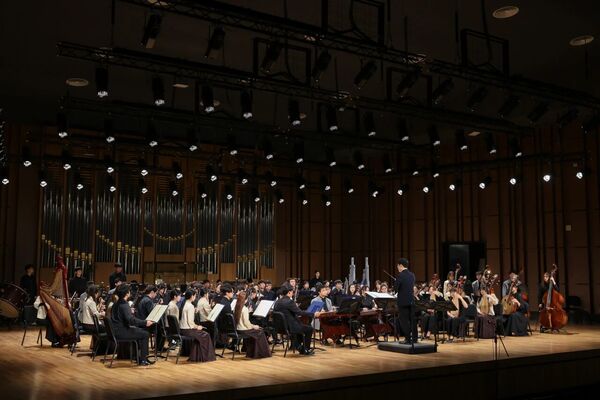
The faculty and student ensemble of Zhejiang Conservatory of Music took turns performing on stage, showcasing the essence of the Zhejiang school of traditional Chinese music. The Xuan Dong Yangqin Ensemble performed “Xuan Dong Jiangnan” (“Vibrant Jiangnan”), using the lively, sparkling tones of the yangqin as a brush to depict the gentle elegance of the Jiangnan water towns—seamlessly integrating traditional Chinese musical rhythms with contemporary compositional techniques to create a fresh, modern interpretation of Jiangnan’s musical heritage. “He He” Jiangnan Silk-and-Bamboo Music Studio performed “Zhong Hua Liu Ban” (“Middle Flower Six Beats”) and “Deng Yue Jiao Hui” (“Lanterns and Moonlight in Mutual Radiance”), presenting exquisitely refined, subtle, and enduring silk-and-bamboo ensemble playing that precisely embodied the Zhejiang school’s artistic characteristics: freshness, elegance, and profound, lingering resonance. A collaborative performance of “Women’s Flower” by erhu and dizi featured gracefully lyrical bowing and tender, expressive flute tones, with richly layered textures and deeply emotive melodies that resonated powerfully with the audience, earning sustained applause. The joint ensemble segment elevated the concert to its climax. Musicians from both sides collaborated on “Qing Qing Si Nian” (“Gentle Longing”) and “Chun Hua Qiu Shi” (“Spring Blossoms, Autumn Fruits”). The profound resonance of Taiwan’s orchestral traditions intertwined harmoniously with the delicate artistry of Zhejiang Conservatory’s traditional Chinese music, creating a resonant dialogue between silk-and-bamboo ensembles and Western orchestral instruments. Through music, they expressed their shared cultural roots and deep emotional bonds; through melody, they affirmed the powerful unifying force of traditional Chinese music within the Chinese nation.
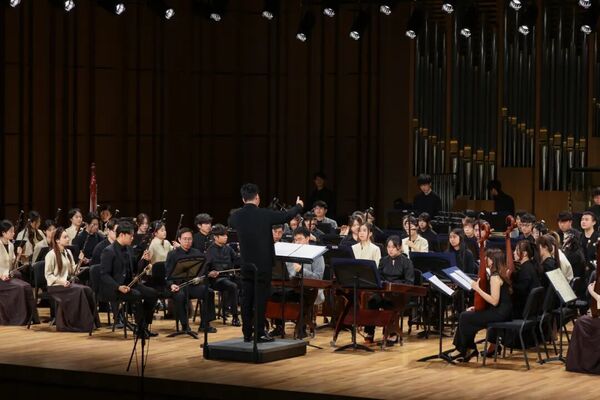
This exchange event, with music as its bond and art as its bridge, not only provides a professional platform for musicians from Hangzhou and Taiwan to hone their skills and learn from one another, but also deepens compatriots’ identification with and understanding of Chinese musical culture through the interpretation of classics and integrated ensemble performances. Musicians from Hangzhou and Taiwan connect hearts through music and unite strength through art—exploring the roots of traditional Chinese music within the continuity of cultural heritage and building bridges of emotional resonance and cultural integration through artistic dialogue. This event strikes a harmonious and beautiful chord of unity and shared progress, further promoting cultural and artistic exchanges and integration between Hangzhou and Taiwan, and jointly advancing the inheritance and innovation of China’s outstanding traditional culture across the strait.
 #1 Zheyin Road, Zhuantang Street, Xihu
District, Hangzhou, Zhejiang Province, China 310024
#1 Zheyin Road, Zhuantang Street, Xihu
District, Hangzhou, Zhejiang Province, China 310024 international@zjcm.edu.cn(for general
inquiries) admission@zjcm.edu.cn(for admission of international students)
international@zjcm.edu.cn(for general
inquiries) admission@zjcm.edu.cn(for admission of international students) +86-571-89808098 +86-571-89808099