On November 11, the “2025 Zhejiang Conservatory of Music Electroacoustic Music Academic Season,” hosted by Zhejiang Conservatory of Music and co-organized by its Center for Electroacoustic Music and the Department of Composition and Conducting, officially commenced. Spanning four days, this event focuses on core research areas including electroacoustic music composition, algorithmic composition, interactive music, 3D audio technology, and music aesthetics, featuring a series of academic lectures, premieres of cutting-edge software, concerts showcasing works by Chinese and international composers, and international academic exchanges. That evening, the opening ceremony of the Electroacoustic Music Academic Season and the concert of works by Chinese and international composers were held in the Standard Concert Hall. Present at the opening ceremony were Wang Rui, President of Zhejiang Conservatory of Music; Cai Yijun, Party Committee Deputy Secretary; Wang Yang, Vice President; Li Jun, Party Committee Member and Director of the Organization Department; Shi Ying, Party Committee Member and Director of the Publicity Department ; as well as scholars and experts from institutions including the Conservatoire National Supérieur de Musique et de Danse de Paris (CNSMDP) in France, IRCAM—Institut de Recherche et Coordination Acoustique/Musique in France, INA-GRM—Institut National de l’Audiovisuel–Groupe de Recherches Musicales in France, the French Ensemble Intercontemporain, the Haute École de Musique de Genève in Switzerland, the Berlin University of Applied Sciences in Germany, the Conservatorio di Musica “Luigi Cherubini” in Florence, Italy, the Korean Electroacoustic Music Association, the Central Conservatory of Music in China, and the Shanghai Conservatory of Music.
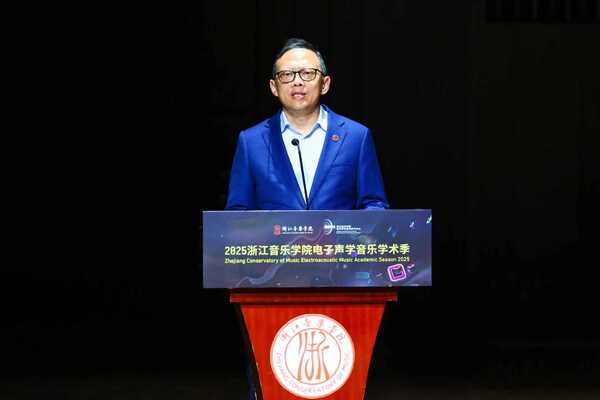
In his speech, Wang Rui stated that electroacoustic music—a cutting-edge field where music and technology deeply converge—has consistently expanded the boundaries of traditional sound through broad imagination and an exploratory spirit, creating distinctive sonic landscapes. Today, as information technology and artificial intelligence sweep across the globe, the technological revolution brings to music not merely updated tools, but a fundamental expansion of thinking paradigms and expressive dimensions. He emphasized that, no matter how advanced technology becomes, music remains, at its core, an art form centered on human experience, emotion, and soul. The present and future of electroacoustic music must steadfastly uphold a human-centered philosophy—grounded in understanding contemporary people and reflecting reverence for and care toward life, society, and nature. He expressed hope that, through this Music Academic Season—featuring interdisciplinary and cross-media collaboration—we can inspire young artists to boldly explore new frontiers, transforming technology into a bridge for expressing life and gaining insight into humanity, and collectively building the Zhejiang Conservatory of Music’s Electroacoustic Music Research Center into an open, innovative platform that contributes new chapters to the advancement of contemporary Chinese music composition and the development of global musical civilization.
Professor An Chengbi, Director of the Department of Composition and Conducting and Director of the Digital Music Zhejiang Engineering Research Center, briefly introduced the basic framework and distinctive highlights of this Academic Season. He noted that this season features nine carefully curated lectures and five concerts, designed to showcase diverse, avant-garde ideas and artistic forms, thereby opening up new perspectives for musical creation. Electronic music has unlocked boundless creative possibilities for contemporary composers; through this academic exchange, he hopes to further enrich the artistic depth of music and support talented young students and composers in realizing their aspirations. He is confident that this Center will become a pivotal platform driving the development of electronic music in China and writing bold new chapters.
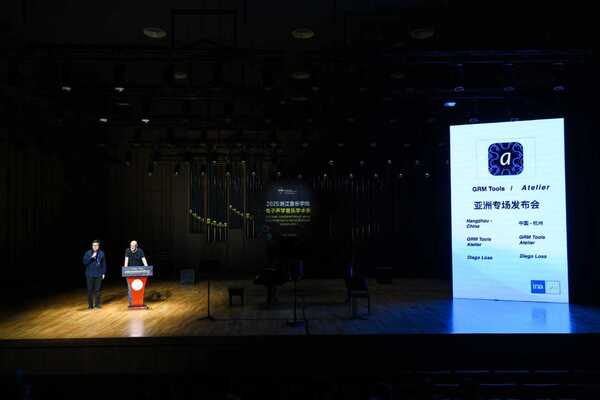
Professor Diego Losa of France's INA-GRM National Audiovisual Research Institute officially released the "GRM Tools Atelier" software. Professor Losa systematically reviewed the development history of GRM Tools over more than half a century, pointing out that its spiritual foundation originates from the core concepts established by electronic music pioneer Pierre Schaeffer. The release is not simply "GRM Tools 4," but rather "GRM Tools Atelier," which has undergone a complete reconstruction and innovation of its underlying architecture. The biggest highlight of this new product lies in its high level of integration and modularity: functions that previously required multiple plugins in series or parallel are now fully integrated into a single plugin interface, greatly enhancing creative freedom and efficiency. However, the core innovation is its revolutionary spatial audio processing capability. "GRM Tools Atelier" deeply integrates various spatialization tools, allowing users to intuitively design and control the sound field directly within the plugin without manually specifying the physical speaker positions for the sounds. This breakthrough marks a major leap for sound creation tools in the spatial dimension.
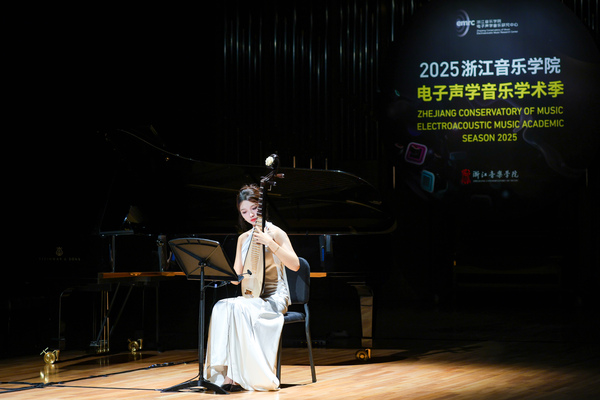
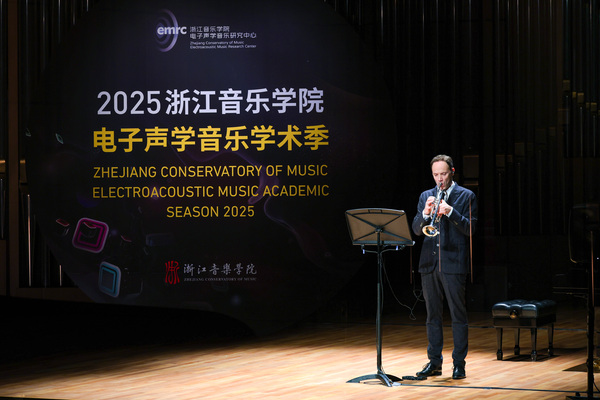
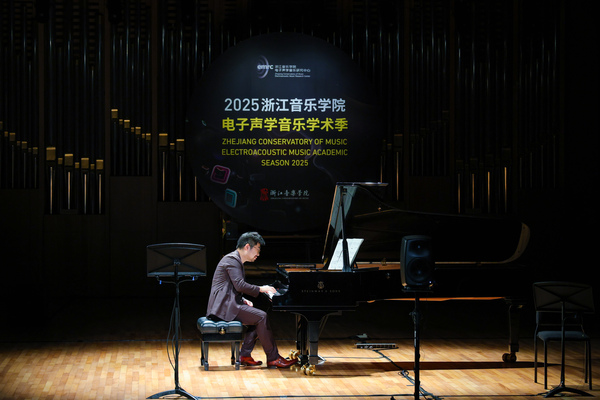
The first "Concert of Works by Chinese and Foreign Composers" was immediately staged, featuring six electronic music works created by Korean composer Oh Yi-min, Chinese composer Wang Tiantian, Italian composer Lala Morciano, Chinese composer Ainivar Vajidin, French composer José Miguel Fernández, and Chinese composer Professor An Chengbi: "Charming Tinnitus " for violin and electronic music, "Zero-Dimensional Space" for solo trumpet and 5.1 surround system, "Embedded Entanglement" for flute and real-time electronic sound, "Whispers of the Field" for pipa solo and electronic music, "Sundial" for trumpet and immersive real-time electronic music, and "Tone" for solo piano and electronic music. These six mixed electronic music works vividly depict the touching scene of the integration of technology and art, opening a brilliant prelude to the current music academic season activities.
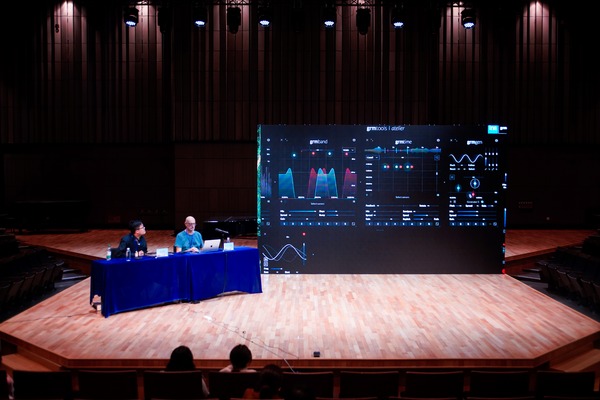
On the same day, there were also special lectures: "Autogamie – Between System and Ecstasy" by German composer Sasha Jankó Dragić, and "GRM Tools Atelier" by Professor Diego Losa. The core of both lectures was to showcase a unique compositional thinking that lies between a highly rational "System" and intuitive sensory "Ecstasy", bringing a deep intellectual collision to the academic season.
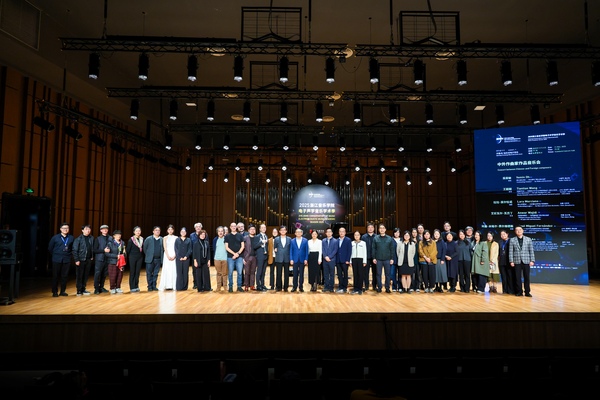
Electroacoustic music, embracing the integration of “Music & Technology,” actively responds to the developmental trends of the digital era. This Music Academic Season not only continues the original mission behind the establishment of the Electroacoustic Music Research Center in 2023 but also constitutes a profound exploration of the fundamental nature of technology and the essential essence of art. With an ambitious vision, rich content, and forward-looking orientation, the event features nine academic lectures by domestic and international experts, as well as five international exchange concerts involving conservatories and institutions from around the world. Among the 36 works performed, numerous pieces premiere globally, nationally (in China), and locally (in Hangzhou), fully demonstrating broad international perspectives and vibrant creative energy. A highlight of the season is the International Conservatory Student Works Exchange Concert, which brings together new compositions by students from Zhejiang Conservatory of Music, the Conservatoire de Paris (CNSMDP) in France, the Haute École de Musique de Genève in Switzerland, and the Hochschule für Musik Carl Maria von Weber Dresden in Germany. Additionally, the Music Academic Season will host an International Academic Symposium on Conservatories and Institutions, where composers, scholars, and students from China and abroad will engage in in-depth dialogue on pedagogy, technology, and aesthetics in electronic music composition—transforming brief academic exchanges into sustained intellectual interaction and broader industry impact.
 #1 Zheyin Road, Zhuantang Street, Xihu
District, Hangzhou, Zhejiang Province, China 310024
#1 Zheyin Road, Zhuantang Street, Xihu
District, Hangzhou, Zhejiang Province, China 310024 international@zjcm.edu.cn(for general
inquiries) admission@zjcm.edu.cn(for admission of international students)
international@zjcm.edu.cn(for general
inquiries) admission@zjcm.edu.cn(for admission of international students) +86-571-89808098 +86-571-89808099